
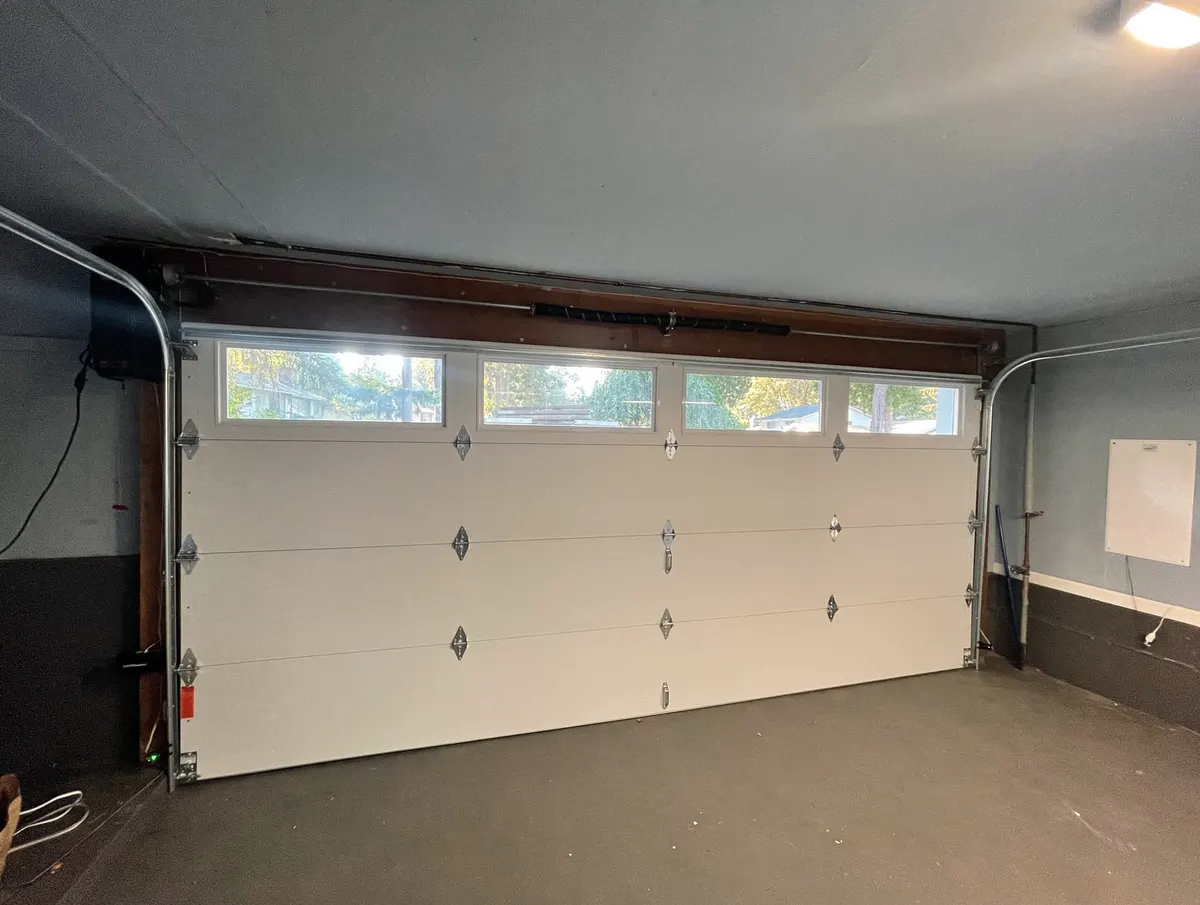
You're standing in the garage, watching the door close, and you realize it just doesn't stop when your foot is in the way. No beam of light crosses the opening near the floor. No little sensor eyes on either side of the track. You call out to your spouse: "Did you know this thing has no safety sensors?" And now you're in an argument about whether the door that's worked fine for thirty years is suddenly a problem.
Here's the honest answer: some parts of an old garage door are a real safety gap. Others are just old, and old doesn't mean dangerous. The trick is knowing which is which before you spend money or, worse, ignore something that actually matters.
What to Retrofit, No Debate
A few things on a pre-2000 garage door aren't about style or preference. They're about what happens in the two seconds before someone gets hurt.
- Photo-eye safety sensors. Federal rules have required auto-reverse sensors on residential openers since the mid-1990s, but plenty of older openers in original condition on older housing stock never had them installed, or the sensors were bypassed years ago because they kept tripping. If your door closes on an obstruction without stopping or reversing, that's not a quirk, it's a missing safety feature. Retrofitting photo eyes onto an older opener is usually straightforward and should not wait.
- Auto-reverse mechanism. Separate from the sensors, this is the mechanical or electronic function that reverses the door if it meets resistance while closing. Test it: lay a 2x4 flat on the ground where the door closes. If the door doesn't reverse on contact, the opener needs replacement, not a patch.
- Frayed or rusted lift cables. Decades of humid summers followed by salty, icy winters are hard on exposed metal. If you see rust bloom, kinks, or individual strands separating from the cable, that's a load-bearing part failing, and it should be replaced before it snaps under tension.
- Springs without a containment cable. Older torsion and extension springs were sometimes installed without a safety cable running through the center. If a spring like that breaks, it can whip loose with real force. This is worth checking even if the spring itself still looks fine.
- Exposed pinch points on older panel designs. Some original doors from this era have sections that create a sharper pinch point between panels than modern doors do. If you've got kids or grandkids who like to watch the door operate, this is worth a second look.
What's Fine to Leave Alone
Not everything original is a liability, and it's worth saying that out loud so the argument doesn't swing too far the other way.
- Solid, undamaged panels. If the door itself, wood or steel, is straight, free of rot or rust-through, and seals properly, there's no safety reason to replace it just because it's old. Plenty of original doors on older homes in this area are still structurally sound; they just look dated.
- Manual lock mechanisms. The slide bolt or T-handle lock on an older door is mechanically simple and usually still works fine. It doesn't need to be swapped for anything smart unless you want the convenience.
- Basic steel track and rollers, if they're not worn. Track doesn't go bad just because it's old. It goes bad when it's bent, rusted through, or misaligned. Check with a level and a flashlight before assuming it needs replacement.
- The overall look. Nothing about an original door's style, color, or window pattern is a safety issue. That's a taste decision, not a risk decision, and it's fine to save it for another conversation.
Why This Matters More Here Than in Other Climates
Salt and freeze-thaw cycles accelerate corrosion on cables, hinges, and spring coils faster than a dry climate would. A cable that might last another five years somewhere warmer can degrade faster here after repeated winters of road salt tracked in and humidity swings in the summer months. That's part of why a visual check before winter sets in matters more in this area than the manual suggests.
When to Call Morganville Garage Door
If you've tested the auto-reverse with the 2x4 trick and it failed, or you can see daylight through a frayed cable, that's not a weekend project. Morganville Garage Door handles opener repair and installation for exactly this situation, retrofitting modern safety sensors and auto-reverse logic onto openers that predate current standards, without necessarily replacing the whole door. We also handle spring replacement, including adding containment cables to older torsion springs that were installed without them. We'll tell you plainly if your original door just needs a safety upgrade or if it's genuinely at the end of its service life.
If something about your garage door has been bothering you enough to bring it up at dinner, give Morganville Garage Door a call. We serve Morganville, Marlboro, Old Bridge, Matawan, Aberdeen, Freehold, Holmdel, and Sayreville, and we'll settle the argument with a straight answer.